Six months after training, someone will ask which data version the model saw, why a variable was dropped, or how the decision threshold was chosen. An auditor, a Notified Body (the independent organisation that assesses medical devices for CE marking) or a clinician investigating an incident needs the same answers. If you write them down while you work, you can give them; if you reconstruct them later, you will miss things.
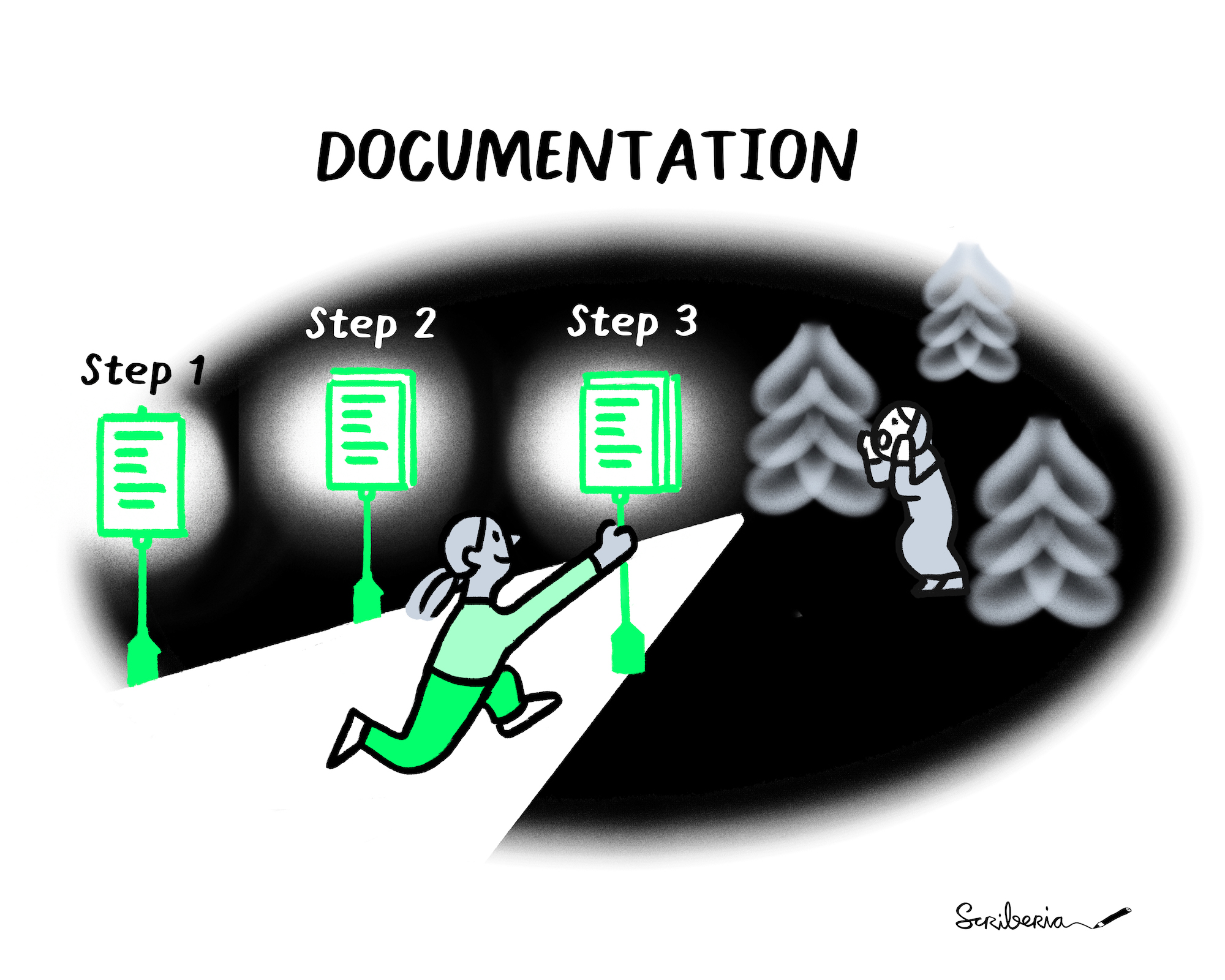
The Turing Way Community. This illustration is created by Scriberia with The Turing Way community, used under a CC-BY 4.0 licence. DOI: 10.5281/zenodo.3332807.
What to document
Model card
A model card is a short, standard document that describes a model and travels with it Mitchell et al. (2019). It covers:
Model details: architecture, version, training date, contact
Intended use: main use, intended users, uses that are out of scope
Factors: patient, environmental and technical factors that affect performance
Metrics: which performance measures you report and why
Training and evaluation data: what they contain, how diverse they are, their limitations
Quantitative analyses: performance broken down by relevant subgroups
Ethical considerations: risks and how you address them
Caveats and recommendations: known limitations and what they mean in practice
Datasheet for the data
A datasheet does for a dataset what a model card does for a model Gebru et al. (2021). It answers why the dataset was created, what it contains, how data and labels were collected, what preprocessing was applied, which uses are appropriate and which are not, how it is distributed and under what licence, and who maintains it.
Technical documentation for regulators
If your system is a medical device, the MDR requires technical documentation (Annex II) before CE marking European Parliament and Council (2017). If it is also a high-risk AI system under the EU AI Act, Art. 11 and Annex IV add AI-specific content European Parliament and Council (2024). Both expect, among other things:
A general description of the system and its intended purpose
Its components and how they interact
How the model was trained and tested, and on which data
Validation results
Risk management documentation
Instructions for use
A model card and datasheet do not replace this, but most of their content feeds into it.
Version control
Keep code, configuration, preprocessing scripts and documentation under version control, using a standard system such as Git. Write commit messages that explain why a change was made as well as what changed. Tag each release that corresponds to a model version, and record for every model version the exact data version and code version used to train it.
Reproducibility
A model is reproducible when someone else can retrain it from your records and get the same or very close results. Write the full preprocessing pipeline as code, with no manual steps. Pin every dependency in a lockfile and record the hardware and software environment (processor or GPU type, driver and library versions). Fix and record random seeds. On GPUs, seeds alone do not guarantee identical results, because some operations are non-deterministic; enable your framework’s deterministic settings if you need exact repeats, or accept results that are close to identical and say so.
- Lekadir, K., Frangi, A. F., Porras, A. R., & others. (2025). FUTURE-AI: international consensus guideline for trustworthy and deployable artificial intelligence in healthcare. BMJ, 388, e081554. 10.1136/bmj-2024-081554
- Mitchell, M., Wu, S., Zaldivar, A., & others. (2019). Model cards for model reporting. Proceedings of the Conference on Fairness, Accountability, and Transparency, 220–229. 10.1145/3287560.3287596
- Gebru, T., Morgenstern, J., Vecchione, B., & others. (2021). Datasheets for datasets. Communications of the ACM, 64(12), 86–92. 10.1145/3458723
- European Parliament and Council. (2017). Regulation (EU) 2017/745 on medical devices (MDR) [Techreport]. Official Journal of the European Union.
- European Parliament and Council. (2024). Regulation (EU) 2024/1689 of the European Parliament and of the Council on artificial intelligence. Official Journal of the European Union.