Before anyone writes code or requests data, a team has to decide which clinical problem it is solving, for whom, with what data, and under which rules. This section covers those decisions. A wrong choice here (the wrong outcome to predict, a missing user group, an unplanned legal basis) is expensive to undo once a model exists.
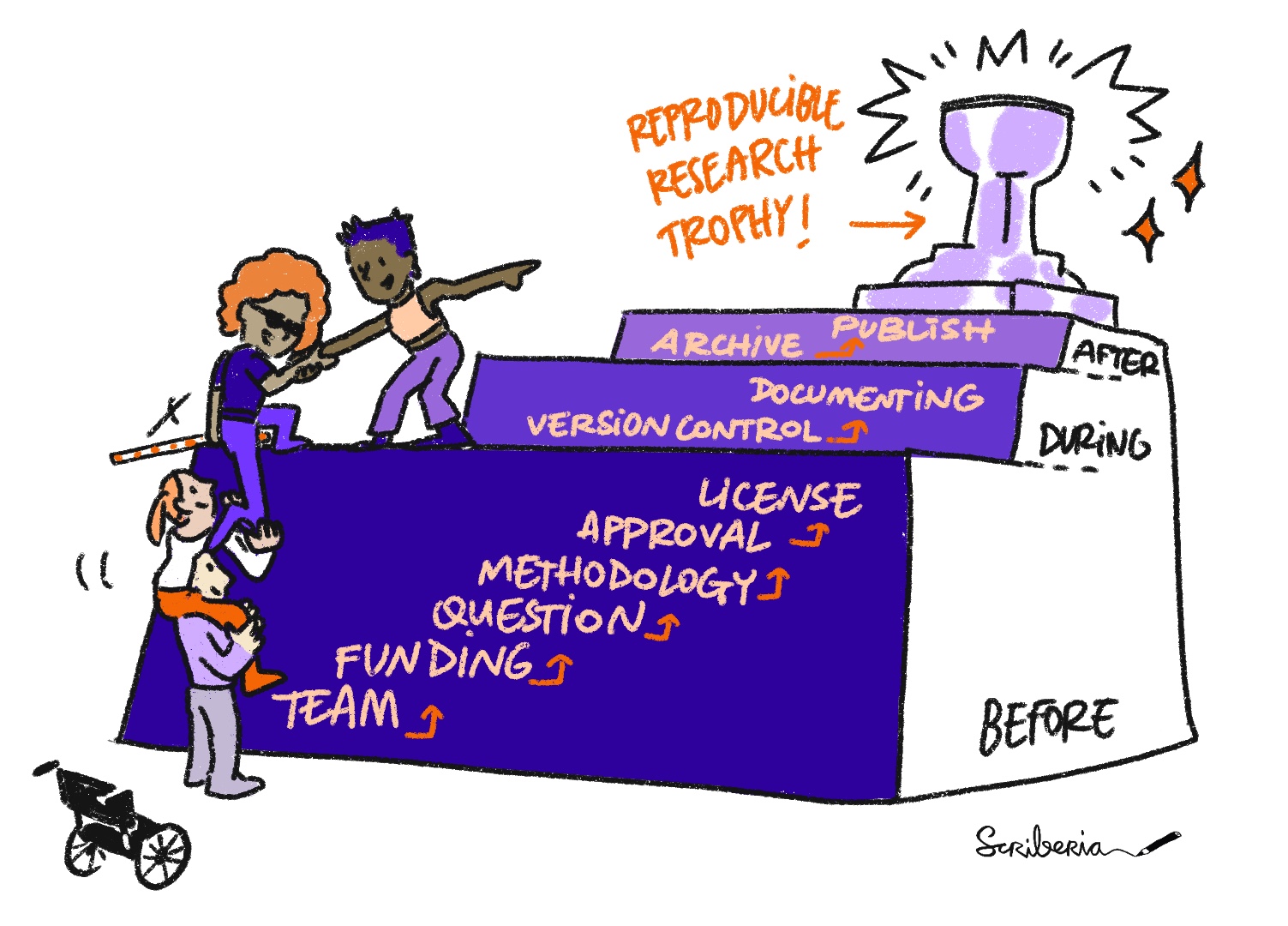
Figure 1:The Turing Way Community. This illustration is created by Scriberia with The Turing Way community, used under a CC-BY 4.0 licence. DOI: 10.5281/zenodo.3332807.
FUTURE-AI Lekadir et al. (2025) places ten of its recommendations in the design phase: G1 (engage interdisciplinary stakeholders), Us1 (intended use and user requirements), Un1 (intended clinical settings and cross-setting variations), Un2 (community-defined standards), R1 (sources of data variation), F1 (potential sources of bias), E1 (explainability needs and requirements), T1 (risk management process), G6 (application-specific ethical issues) and G7 (social and societal issues). The chapter on legal and regulatory questions also starts work on G5 (regulatory requirements). FUTURE-AI places G5 in deployment, but the regulatory route shapes design choices long before go-live.
Chapters in this section
| Chapter | What you will learn |
|---|---|
| Problem definition and scoping | How to state a clinical problem, scope the AI tool and set success criteria before you see any data |
| Stakeholder engagement | Who to involve, when, and how, including patients |
| Intended use and user requirements | How to describe settings, user groups, interaction and explainability needs |
| Ethical review and approval | Which review your project needs in the Netherlands, and which ethical questions to work through |
| Data strategy | How to plan representative data and labels before collection starts |
| Legal and regulatory considerations | How the EU AI Act, MDR/IVDR, GDPR and Dutch law apply to your tool |
| Risk management planning | How to open a risk management file and keep it up to date |
| Identifying sources of bias | Where bias enters through data, labels and problem framing |
| Social and societal impact | Effects on staff, equity, the environment and the patient-clinician relationship |
- Lekadir, K., Frangi, A. F., Porras, A. R., & others. (2025). FUTURE-AI: international consensus guideline for trustworthy and deployable artificial intelligence in healthcare. BMJ, 388, e081554. 10.1136/bmj-2024-081554