The ELSA Way divides the life of a healthcare AI tool into four phases that repeat: design, development, evaluation and deployment.
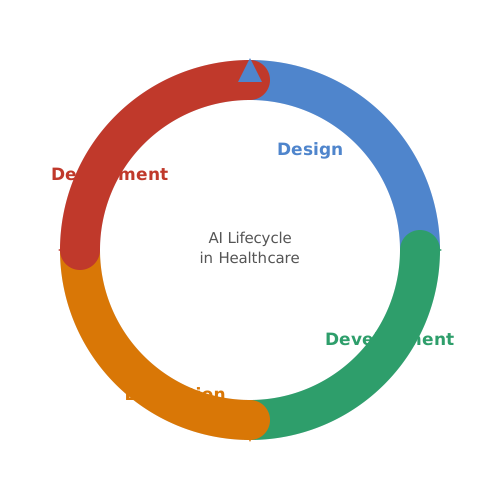
Figure 1:The AI development lifecycle as used in The ELSA Way.
The four phases
1. Design
Key people: clinicians, patients, ethicists, legal experts
In design you define the clinical need and the intended users, plan the data, arrange ethical and legal review and start a risk management process. Mistakes made here, such as solving the wrong problem, leaving out a group of users or planning a dataset that misses part of the patient population, carry through every later phase.
2. Development
Key people: developers, data scientists, researchers
Development is where you collect and curate data, train models, put privacy and security measures in place and design how users will work with the tool. You check that the training data represent the patients the tool is meant for and are labelled consistently, and you record design decisions so that others can trace them later.
3. Evaluation
Key people: clinicians, patients, researchers, ethicists
A first estimate of performance comes from a held-out test set, data kept apart from training and used once at the end. Evaluation goes further: you validate the tool on data from other hospitals, compare performance across patient groups, test usability with real users, study clinical benefit and safety, and check how it copes with messy real-world data and whether its explanations help. Report the results using a guideline such as TRIPOD+AI Collins et al. (2024).
4. Deployment
Key people: hospital management, IT, clinicians, regulators
Deployment starts the tool’s working life. It covers integration into clinical work, checks on inputs and outputs, monitoring for falling performance, periodic audits, logging, staff training, compliance with the MDR or IVDR European Parliament and Council (2017) and the EU AI Act European Parliament and Council (2024), and governance that makes clear who is accountable.
Why a cycle
Each phase feeds the others. Evaluation results send you back to design or development. Monitoring after go-live reveals new risks that call for a new evaluation. Feedback from patients and staff can change how you define the problem in the next round.
- Collins, G. S., Dhiman, P., & others. (2024). TRIPOD+AI statement: updated guidance for reporting clinical prediction models that use regression or machine learning methods. BMJ. 10.1136/bmj-2023-078378
- European Parliament and Council. (2017). Regulation (EU) 2017/745 on medical devices (MDR) [Techreport]. Official Journal of the European Union.
- European Parliament and Council. (2024). Regulation (EU) 2024/1689 of the European Parliament and of the Council on artificial intelligence. Official Journal of the European Union.